After-hours cover is the only front-office decision that costs real money every month. Most practices make it on instinct. This is the arithmetic that makes it on evidence instead.
Friday, 6:40pm
Monday, the meeting
What you will end up with
- After-hours cover is the one front-office decision with a recurring cost, which is why it deserves arithmetic rather than instinct.
- Correct your raw after-hours count for the patience rate. Patients who ring back in the morning are not lost revenue.
- Buy the window your distribution actually shows. Most practices need a narrow band, not 24/7.
- Write the escalation rule before you buy anything, and read point 3 aloud to test it.
- Set the kill criterion on day minus seven. A trial without one becomes a subscription nobody will cancel.
Lessons13
Every other front-office improvement is a one-off. You reorganise a roster, you rewrite a message, you move a lunch break, and the cost lands once. After-hours cover is different: it is a recurring monthly line that continues for as long as you keep it, which makes it the one decision in this area worth doing arithmetic on rather than instinct.
Most practices decide it the other way round. Someone raises it after a bad week, the practice either buys something or does not, and eighteen months later nobody can say whether it worked because nothing was measured before it started.
That pattern is not carelessness. A bad week produces a vivid memory and no data, and a vivid memory is a poor guide to a recurring cost precisely because it is memorable. The weeks that were fine leave no impression at all, which is why the instinct almost always argues for spending.
This guide is the arithmetic. Eight lessons, about five hours of work, and the output is a decision you can defend in either direction. Deciding not to cover after hours is a perfectly good result, and one of the two most common honest outcomes.
What this decides, and what it deliberately leaves alone
By the end you will have a measured picture of after-hours demand, a costed value for it in your own numbers, the four cover models compared against your actual pattern, a written escalation rule, and a trial designed so its result is not arguable. That is the whole scope, and it stops short of implementation on purpose.
What it leaves alone is clinical after-hours care. Cover here means someone or something answering the phone, capturing what the patient needs, and routing anything urgent to a human immediately. It does not mean triage, advice, or any clinical judgement, and a guide that blurred those would be doing harm.
It also leaves alone the question of whether your practice should extend its opening hours. Covering an hour and staffing an hour are different decisions with different costs, and conflating them is the most common way this conversation goes wrong in the first ten minutes.
Covering an hour means a patient reaches something. Staffing an hour means a clinician is available. The first costs a fraction of the second, and most practices arguing about the second actually need the first.
The national context matters here more than in most front-office decisions, because after-hours demand is partly a function of how hard the in-hours system is to reach. In 2024 to 2025, 26.0% of Australians reported waiting longer than they felt acceptable for a GP appointment [1]. Among people who needed urgent medical care, 41.6% were seen within 4 hours [1]. And 26.6% delayed or did not see a GP when they needed to [1].
Those figures describe the population, not your practice. Their use here is as a reminder that a meaningful share of the people who ring you after hours are not ringing out of preference. They are ringing because that was the first moment they could.
Measure what actually arrives after close
Start with counts, because the entire decision rests on a number most practices have never looked at.
Pull one ordinary month of call records and filter to calls that arrived outside your genuinely covered window, which is not the same as outside your stated opening hours. Lunch, waiting-room duty and diverts all create uncovered time inside the working day, and an access audit will have already established where those sit. If you have not done one, the access audit guide produces exactly the inputs this lesson needs.
Produce four counts:
- Calls arriving between close and midnight.
- Calls arriving between midnight and open.
- Calls arriving on weekends and public holidays.
- Calls arriving in the uncovered gaps inside the working day.
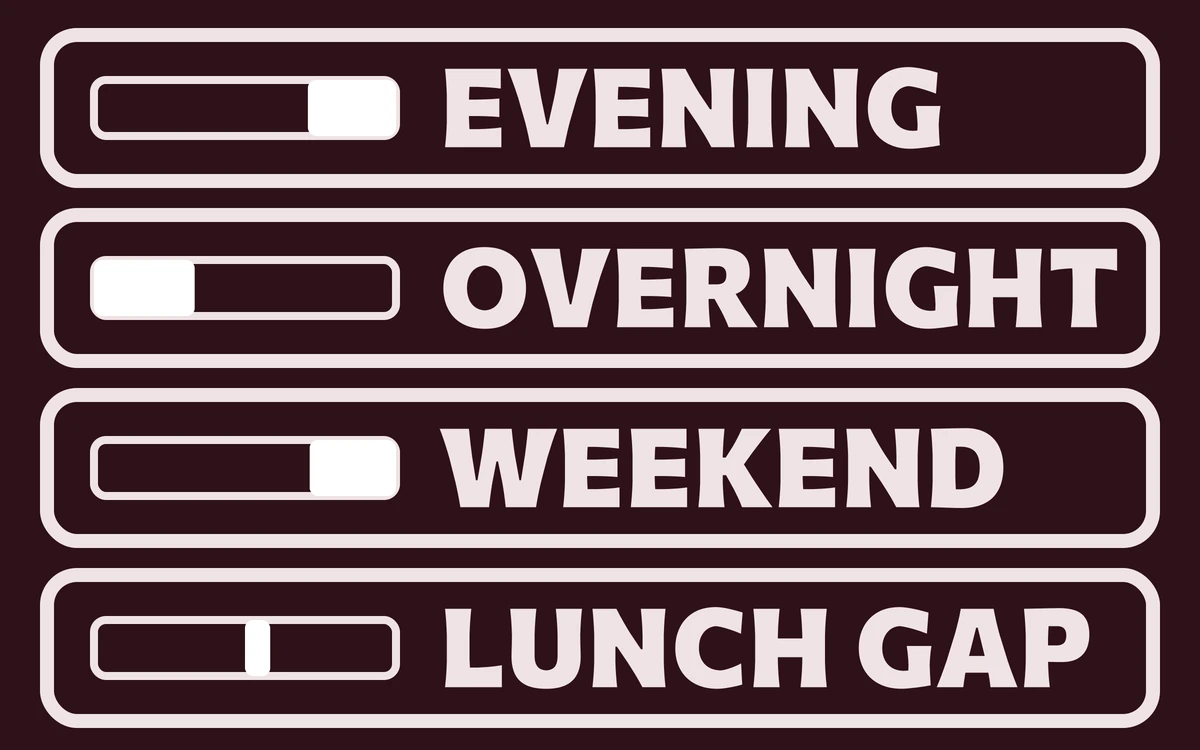
Then split each by weekday, because the shape matters more than the total. A practice with 40 after-hours calls a month spread evenly has a different problem from one with 40 concentrated on Monday and Friday evenings, and the second is far cheaper to solve.
The second band, midnight to open, is usually tiny and is worth isolating precisely so you can stop thinking about it. Very few practices have a genuine overnight case, and carrying overnight in the back of your mind inflates every cover quote you look at.
Two counting decisions need settling before the numbers mean anything, and getting them wrong is how a practice ends up arguing about a figure rather than acting on it.
The first is what to do with repeat attempts from the same number. One patient who rings three times in an evening is one person with one need, not three units of demand. If you are sizing demand, collapse them. If you are sizing how annoying the experience was, do not. Pick one, write it at the top of the sheet, and stay with it.
The second is whether to include calls that arrive during your stated hours but inside an uncovered gap. They belong in the count, because they are lost for exactly the same reason, but they belong in their own row because the fix is completely different and far cheaper. A lunch gap is solved by moving a break. An 8pm call is not solved by anything free.
Look at the weekday split before you look at the total. The shape is what determines cost, and two practices with identical monthly totals can face quotes that differ by a factor of three because one has a tight cluster and the other has a smear across seven days.
Expect Monday and the first evening after a public holiday to be the heaviest. Both are backlog rather than demand, which matters when you size cover: backlog is compressible and a genuine evening pattern is not.
Separate the patient who waits from the one who leaves
A raw after-hours count overstates the opportunity, and correcting for that is the difference between a credible business case and one that falls apart under questioning.
Some callers who get nothing at 7pm simply ring back at 9am. They cost you nothing except goodwill. Others do not ring back at all. Only the second group represents demand you are actually losing, and the ratio between them is specific to your practice.
Measure it directly. Take the after-hours ring-outs from one week and check whether each number appears in the following two days of answered calls:
| Group | What it means | What it is worth |
|---|---|---|
| Rang back and got through | Patience, not loss | Goodwill and risk, not revenue |
| Rang back and failed again | Compounding friction | Counts as loss, and worse for reputation |
| Never rang back | Demand genuinely lost | The number your case rests on |
Expect the patience rate to be higher than you want and lower than a sceptic will assume. Whatever it is, it is now a measured figure rather than a position in an argument, which is the point of the lesson.
- Rang back and got throughCosts goodwill and adds risk. It is not lost revenue and counting it as such will sink your case.
- Rang back and failed againCompounding friction. Counts as loss, and does more reputational damage than a single miss.
- Never rang backThe only group your business case should rest on. Measure it, do not assume it.
Do this for one week and not one day. A single day gets distorted by whatever happened that day, and the correction you are computing gets applied to a whole month of volume, so an error here scales.
There is a subtlety worth catching. A patient who rings after hours, gets nothing, and then books online overnight has not been lost, and they will not appear in your answered calls the next morning either. If you take online bookings, check for a booking from that number or that name before counting the call as lost. Practices with a decent online booking path routinely find that a third of what looked like after-hours loss simply moved channel.
The opposite correction also exists and it works against you. A patient who rings at 7pm, gets nothing, rings a different practice at 7:05pm and books there will never appear in any of your data at all. You cannot measure that group directly. What you can do is stop treating your measured loss as the ceiling, because it is the floor.
State both corrections when you present the number. A business case that says "here is what we measured, here is what it misses in each direction, and here is why we still think the range is right" is far harder to dismiss than one that presents a single figure as though it were complete.
Price it in your own numbers
Now convert the lost group into money, using contribution rather than revenue and your own figures rather than a benchmark.
You need three inputs and one of them must be sampled rather than assumed:
- Lost after-hours calls per month, from lessons 1 and 2.
- The share that were new patient enquiries, from sampling twenty of them by hand.
- New patient contribution over twelve months, from your own records.
The sampling step is the one people skip and it is the one that decides whether the number survives. Suppliers, wrong numbers, and existing patients ringing about something trivial all sit in that raw count, and applying a guessed proportion to a real volume produces an authoritative figure that is wrong.
For a sanity check on labour cost, median hourly earnings across all Australian employees were $42.90 in August 2025, and median weekly earnings $1,425 [2]. That is an all-occupations figure, not a front-desk rate, so use it to check your own number is plausible rather than in place of it.
Use contribution, not revenue. A new patient generating $900 of revenue at 30% contribution is worth $270 to this decision. Building the case on the $900 produces a number roughly three times too flattering.
Express the result as a range with the assumptions written beside it. A figure presented as "between $2,400 and $6,800 a month, and here is why the band is that wide" survives scrutiny. A single confident number does not survive the first person who asks how it was derived.
Then do one more calculation that most practices skip, and it is the one that usually changes the decision. Work out what the cover would have to recover in order to pay for itself, and express that as a number of patients per month rather than as dollars.
The dollar version of a break-even is abstract and easy to argue about. The patient version is not. "This has to convert two new patients a month to wash its face" is a sentence anyone in the practice can evaluate against their own sense of the phones, and it collapses a long meeting into a short one. If the answer comes out at eleven patients a month, most practices stop there and have saved themselves a trial.
Be careful to compute break-even on contribution and against the full cost of the model, including any implementation fee spread over twelve months and any internal time the next-morning review consumes. A model that looks cheap monthly and quietly consumes forty minutes of someone's morning every day is not cheap, and that cost appears in no quote.
- Lost after-hours calls per month, corrected for the patience rate
- Share that were new patient enquiries, from sampling twenty by hand
- New patient contribution over twelve months, not revenue
- A stated range with the assumptions written beside it
- A labour cost sanity check against $42.90 median hourly earnings
Compare the four models honestly
There are four ways to cover after hours, and practices routinely compare only the two they had already heard of.
| Model | Recurring cost | Best when |
|---|---|---|
| Voicemail with a promise | Near zero | Volume is genuinely low and callbacks are reliably honoured |
| Divert to a person on call | Wages or a roster loading | Volume is low but urgency is high |
| Answering service | Per call or per month | Volume is moderate and the need is capture, not judgement |
| Automated front office | Flat monthly | Volume is moderate to high and the questions are repetitive |
| Measure | Model | Cost behaviour |
|---|---|---|
| Voicemail with a promise | Near zero | Only works if callbacks are actually honoured |
| Divert to a person on call | Wages or roster loading | Low volume, high urgency |
| Answering service | Usually metered per call | A busy month produces an unpredicted bill |
| Automated front office | Flat monthly | Repetitive questions, with a person always reachable |
Two honest notes about the bottom row, which is the category this site sells into.
The first is that flat and metered pricing behave very differently as you grow. Most services in this market meter by call or by minute, which means a busy month produces a bill nobody predicted. A flat monthly fee does not move. That is the argument that needs no case study, and it is the one worth checking in any quote you receive.
The second is that automation is only the right answer for the repetitive middle of your call mix. Anything clinical, anything distressing, and anyone who asks for a person must reach a person. Our position on that is written up in what we will not do, deliberately as a refusal rather than a feature.
If you are comparing options, the vendor checklist has the questions worth asking before anything is signed, and our pricing is published rather than quoted so you can finish this lesson without a sales call.
Score the four models against your own pattern rather than in the abstract, because the ranking genuinely inverts depending on what lesson 1 found.
A practice with twelve after-hours calls a month and a reliable person already on call should almost certainly do nothing new. The voicemail row is not a failure of ambition, it is the correct answer at that volume, and the honest version of this guide has to say so on a site that sells the bottom row.
A practice with a hundred and forty calls a month spread across evenings and Saturday has a different problem, and at that volume the metered models become the expensive ones rather than the cheap ones. Ask for the quote at your actual volume and then at double it. The gap between those two numbers tells you more about the vendor's pricing model than any brochure will.
There is one question worth asking every candidate, and the answer is usually revealing: what happens when your system is down? A model with no stated fallback is one that turns a bad night into an unanswered phone with no message, which is materially worse than the voicemail you replaced.
Three more questions separate the models quickly, and all three are about the boring parts rather than the capability.
Ask where the record of each contact ends up, and whether you can export it. A model whose captured requests live only inside a supplier's dashboard is one you cannot leave without losing your history, and the cost of that only becomes visible at the moment you want to switch.
Ask what the caller hears in the first four seconds. This is not a branding question. A caller who cannot tell within one sentence whether they have reached the practice or an unrelated call centre will behave as though they dialled wrong, and a proportion of them will simply hang up and count as a miss on a system you are paying for.
Ask how a regular patient reaches a person without navigating anything. Not whether they can, which every supplier will say yes to, but how: the specific action, and how many steps it takes. The gap between "yes we support that" and "press nothing and wait four seconds" is the whole of the patient experience.
None of those three appears in a feature comparison, and all three will decide whether the thing is still in place in two years or was quietly abandoned after six months while the invoice kept arriving.
Define the hours you actually need
The most expensive mistake in this decision is buying 24/7 when you need 15 hours a week.
Go back to the distribution from lesson 1 and find the smallest window that captures most of the volume. In most practices this is a surprisingly narrow band: the two hours after close on weekdays and Saturday morning. Overnight and Sunday are usually near-empty, and paying to cover them is paying for a feeling of completeness.
Write the window down as specific hours on specific days, not as a phrase. "After hours" is not a specification and cannot be quoted against or measured. "Weekdays 5pm to 8pm, Saturday 8am to 1pm" is both.

Then decide what happens outside even that window, because something must. The honest options are voicemail with a stated callback time, a recorded message directing genuine emergencies to 000, or nothing at all with the phone simply unanswered. All three are defensible. What is not defensible is not having decided, because that is how a patient in difficulty meets an unanswered phone with no instruction.
Resist widening the window during the quote stage. Vendors will price 24/7 readily and the marginal cost often looks modest, which is exactly what makes it tempting. The problem is not the monthly figure. It is that a window you did not need generates contacts you did not plan for, and each one still has to be reviewed the next morning by someone whose morning was already full.
Two practical constraints usually narrow the window further, and both are worth checking before you commit.
The first is when your practice can actually act on what is captured. A request captured at 9pm that cannot be progressed until 8:30am has had its value set by the morning, not by the evening. Covering later into the night adds capture without adding action.
The second is your own callback capacity. If the window produces fifteen callbacks a morning and the desk can absorb six, you have not solved an access problem, you have relocated it to a time when the phones are also ringing.
Write the escalation rule before you buy anything
This is the lesson that protects patients and it belongs before the purchase, not after it.
The rule is a single page and it must state:
- What counts as urgent, in language a non-clinician can apply without hesitating.
- What happens the instant something urgent is identified, including who is rung and on what number.
- The words used to direct a genuine emergency to 000, agreed in advance rather than improvised.
- What is never discussed after hours, including anything clinical the answerer is not qualified to discuss.
- Who reviews after-hours contacts the next morning, and by when.
- How a patient is told when they will hear back, and who is accountable for that being true.
Point 3 deserves testing rather than drafting. Read it aloud. If it is long, hedged, or requires the answerer to make a judgement first, it will fail at the only moment it matters.
Anything clinical, anything distressing, and anyone who asks for a person goes to a person immediately. No efficiency gain anywhere else in this guide is worth weakening that rule.
Point 5 is what stops after-hours cover becoming a queue nobody empties. A captured request that sits unread until Wednesday has not been captured in any sense the patient would recognise, and it is the most common failure mode of every model in lesson 4, including the expensive ones.
Name the reviewer as a role rather than a person, and name a deputy. Roles survive annual leave; people do not, and the fortnight somebody is away is precisely when a queue silently accumulates and the practice learns nothing about it until a complaint arrives.
Give the review a deadline expressed as a clock time, not a sentiment. "By 9:30am each working day" can be checked. "First thing" cannot, and in a busy practice first thing is a moving target that drifts later every week under load.
Before signing anything, test the escalation rule against three cases rather than reading it approvingly. Take a caller describing chest pain, a caller who is distressed but not clinically urgent, and a caller who simply says they would rather speak to a person. Walk each one through the rule as written. If any of the three requires the answerer to improvise, the rule is not finished, and the moment to discover that is now rather than at 9pm on a Friday.
Design the trial so its result cannot be argued with
Run a trial before committing to anything recurring, and design it before it starts rather than analysing it afterwards.
Four decisions, all made in advance:
- Length. Sixty days. Thirty is too short to clear novelty; ninety delays the decision without adding much.
- The measure. Pick one primary number now and write it down. Usually captured after-hours contacts that converted to a booking within seven days.
- The comparison. The same two months last year, or the two months before the trial, and say which before you start.
- The kill criterion. The result that would make you stop. Write it as a number.
- Day -7Baseline lockedComparison period named and written down, with the primary measure.
- Day 0One change onlyCover starts. Nothing else in the front office changes this month.
- Day 30Checkpoint, not a verdictConfirm the change actually started when you think it did.
- Day 60Read against the criterionCompare like for like. The kill criterion was set on day minus seven.
The kill criterion is the one people leave out, and leaving it out is how a practice ends up paying for something for three years because nobody wanted to be the one who called it. Decide in advance what failure looks like, and the decision at day 60 becomes arithmetic rather than politics.
One design caution. Do not change two things at once. A practice that adds after-hours cover and rewrites its recall messages in the same month has learned nothing about either, and will attribute the result to whichever one it preferred.
Record two secondary measures alongside the primary one, chosen in advance so they cannot be invented later to rescue a disappointing result.
The first is the next-morning review time: how long it actually takes someone to clear the overnight queue. This is the number that tells you whether the model is sustainable at this volume, and it is invisible in any vendor reporting because it happens inside your practice.
The second is the escalation count: how many contacts were routed to a person as urgent, and what happened to each. A trial that produces zero escalations across sixty days has either a very healthy patient population or an escalation rule that is not firing, and the second possibility is worth ruling out deliberately rather than assuming the first.
Tell the team the trial is running and what is being measured. A trial run quietly to avoid influencing behaviour usually fails for a different reason: nobody knows the new path exists, so it is not used, and the result measures awareness rather than value.
Read the result honestly
At day 60, compare like for like and resist three specific temptations.
The first is the seasonal excuse. If the trial ran across a period your practice is always quieter or busier, the comparison must use the equivalent period, not the adjacent one. Decide this in lesson 7 so it cannot be relitigated once you can see the result.
The second is moving the measure. If the primary number disappointed and a secondary number looked good, the honest response is to report both and weigh them against the criterion you set. Quietly promoting the secondary number to primary is how organisations keep paying for things that did not work.
- Equivalent period compared, chosen before the trial
- Primary measure reported even when it disappoints
- Null result accepted as a cheap purchase of certainty
- Kill criterion applied as written
- Adjacent period used because it flatters
- A secondary number quietly promoted to primary
- A flat result blamed on the season after the fact
- Nobody willing to be the one who calls it
The third is discounting the null result. If after-hours demand turns out to be small and the trial confirms it, you have bought certainty cheaply and can stop revisiting the question for a year. That is a genuine return on five hours of work, and it is one of the two most common honest outcomes.
There is a fourth temptation and it appears only in trials that went well: expanding immediately. A model that worked across a narrow evening window is not thereby proven across weekends, and extending on the strength of a good result means the extension itself is never measured. If the narrow window worked, run the wider one as its own trial with its own criterion, or accept that you will never know whether it earned its cost.
Write the day 60 result down in three sentences: what was measured, what it came to, and what was decided. Not a report. Three sentences, kept with the baseline from lesson 7. The value of that page is not this decision, which everyone present already understands. It is the next decision, made by people who were not in the room, against a number that would otherwise have been lost.
Where messaging forms part of what you implement, the evidence for reminders specifically is better than for most front-office interventions: a Cochrane review found mobile phone messaging reminders improved attendance at healthcare appointments against no reminder [3]. Note what that says and what it does not. Reminders beat nothing, which is a narrower claim than most vendor material makes of it.
What the decision usually turns on
Across practices that work through this properly rather than arguing about it in a meeting, the outcome hinges on three things far more often than it hinges on price, and price is almost always where the conversation starts. Each of the three is measurable, and none of them appears in a vendor quote.
The first is the shape of the distribution, not its size. A concentrated pattern is cheap to cover and a diffuse one is not, and two practices with identical monthly totals can reach opposite conclusions for that reason alone.
The second is the patience rate from lesson 2. A practice whose patients reliably ring back in the morning is losing much less than its raw count suggests, and the honest version of the business case has to say so.
The third is whether anyone will read the captured requests the next morning. Cover without that is an expensive way to generate a backlog, and it is the failure mode that no amount of spending on the cover itself will fix.
A fourth factor sits underneath all three and rarely gets named: whether the practice has anywhere to put the demand it recovers. Cover converts unmet contact into booked contact, so a practice already booked three weeks out will convert an evening caller into a patient who waits three weeks and is now annoyed at a practice that answered rather than one that did not.
That is not an argument against cover. It is an argument for sequencing. Capacity first, access second, in that order, and a practice that reverses them pays monthly for the privilege of disappointing people faster.
| Situation | What the decision usually is | Why |
|---|---|---|
| Low volume, reliable on-call person | Do nothing new | The voicemail row is the correct answer, not a failure of ambition |
| Concentrated evening cluster, spare capacity | Cover the narrow window | Cheapest case to make and the easiest to measure |
| Diffuse volume across seven days | Model comparison matters most | Metered pricing turns expensive exactly when it is working |
| Any volume, no morning review | Fix the review first | Cover without it manufactures a backlog |
Read that last row as the precondition it is. It is the only one that cannot be bought.
- The shape of the distribution, not its size
- The patience rate, which shrinks the loss and the case with it
- Whether anyone reads the captured requests the next morning
- Whether the escalation rule works when read aloud under pressure
Australian general practice is carrying real load while you weigh this. There were 40,375 GPs in the primary care workforce in 2024, and 71% of GPs now nominate mental health as a leading reason for presentations, up ten points since that survey began in 2017 [4]. Longer, more complex consultations are not an after-hours problem, but they are part of why in-hours capacity is tight, and tight in-hours capacity is what pushes contact outside the working day in the first place.
Australian after-hours demand has been studied directly, including a cross-sectional survey of presentations to community-based primary care across extended-hours general practices, medical deputising services and nurse-led walk-in clinics [5]. The useful thing in that literature is not any single figure but the consistent finding that after-hours contact is a mixed population with a wide range of needs, which is precisely why the escalation rule in lesson 6 matters more than the technology in lesson 4.
When to stop analysing and decide
There is a version of this work where the analysis quietly becomes a substitute for the decision itself. It is recognisable because it keeps generating new questions rather than narrowing the ones already on the table, and because each new question sounds reasonable in isolation.
Stop when you have the four counts, the patience rate, the costed range, the chosen window and the escalation rule. That is enough to either run a trial or decide against one, and both are decisions.
Revisit annually, or whenever your opening hours, your roster or your local after-hours options change. Not quarterly. After-hours demand does not move fast enough to reward that, and a practice measuring it every three months has substituted a reporting habit for a decision. If you want to understand the category of tool being sold into this gap before weighing any of it, the plain-language explainer is the place to start.
Keep the working alongside the decision rather than filing it separately. In eighteen months somebody will ask why the practice pays for this, or why it does not, and the answer needs to be better than a remembered meeting. What that person needs is four counts, a patience rate, a costed range, and one line recording what was decided and on what evidence.
A final note on how to hold the result. Whatever you choose, it is a decision about a pattern that will change. Practices move premises, hours shift, a nearby clinic closes and its patients arrive at your phones, an online booking path goes in and takes a third of the evening volume with it. None of that invalidates the work; all of it changes the inputs.
So write the review date on the page with the decision, and treat the eight figures as a baseline rather than a conclusion. The practices that get the most out of this are not the ones that got the first decision right. They are the ones that could tell, a year later, whether it was still the right decision, because they had kept the number they started from.
Sources
- Australian Bureau of Statistics, Patient Experiences, 2024-25 financial year, released 18 November 2025abs.gov.au
- Australian Bureau of Statistics, Employee Earnings, August 2025, released 12 December 2025abs.gov.au
- Gurol-Urganci et al., Mobile phone messaging reminders for attendance at healthcare appointments, Cochrane Database of Systematic Reviews (2013)pubmed.ncbi.nlm.nih.gov
- RACGP, General Practice: Health of the Nation 2025, access to general practice careracgp.org.au
- After-hours presentations to community-based primary care in the Australian Capital Territory, cross-sectional survey of extended-hours general practices, medical deputising services and nurse-led walk-in clinicspubmed.ncbi.nlm.nih.gov